Short answer: choose silicone when the part must survive continuous heat above 150 °C, hold sealing force for years, or stay flexible below −50 °C. Choose TPE for almost everything else — high-volume, overmolded, cost-sensitive parts — because it molds in seconds on standard presses and its scrap can be reground. Most TPE vs silicone decisions come down to three numbers: service temperature, annual volume, and thermal margin you may never use.
By the FitPoly technical team · Last updated October 2026. FitPoly is a Suzhou-based compounder of TPE, TPU, TPV and TPEE grades.
What is the core difference between TPE and silicone?
Silicone rubber is a thermoset. Two-part liquid silicone rubber (LSR) is metered 1:1, chilled through a cold runner and injected into a mold at 150–200 °C, where a platinum catalyst crosslinks it in 30–90 seconds. Once cured, it cannot be melted — silicone does not flow even at 250 °C.
Thermoplastic elastomer (TPE) runs the other way: pellets melt at 180–240 °C and solidify in a mold at 21–49 °C, so the change is reversible and sprues, runners and rejects go back into the machine. ISO 18064:2022 sorts the family into styrenic (SEBS), olefinic (TPO, TPV), urethane (TPU), copolyester (TPEE) and copolyamide grades, and that family drives performance.
| Factor | TPE | Silicone rubber |
|---|---|---|
| Material type | Thermoplastic, re-meltable | Thermoset, cannot re-melt |
| Processing | Injection, 15–40 s cycles | LSR or compression, 30–90 s plus post-cure |
| Chemical / UV resistance | Good, additive-dependent | Inherent, additive-free |
| Food / medical history | Certified grades available | Decades of FDA, USP and ISO 10993 use |
| Cost per part at volume | Lower | Higher |
| Recyclability | Regrind reusable | Not recyclable |
TPE vs silicone: how do the specs compare?
Ranges below are cross-referenced to published material data (Avient, BPF Plastipedia), standard test methods and 2025 market ranges. Confirm on the grade datasheet.
| Property | TPE compound | Silicone (LSR / HCR) | Test method |
|---|---|---|---|
| Continuous service temperature | 70–100 °C (SEBS); ~130 °C (TPV); up to 150 °C (TPEE) | −60 to +200 °C; ~250 °C HT grades | Datasheets |
| Hardness range | Shore OO 20 – Shore A 95 | Shore A 5–80 | ASTM D2240 |
| Molding and cycle time | Standard injection, 15–40 s | Cold-runner LSR, 30–90 s plus oven post-cure | 2025 process data |
| Specific gravity | 0.89 (SEBS) to 0.95 (TPV) | 1.12–1.15 | ASTM D792 |
| Compression set, 22 h @ 100 °C | 25–55 % | 10–25 % | ASTM D395 / ISO 815 |
| Tooling investment | USD 10,000–50,000 | USD 15,000–80,000 | 2025 quote ranges |
| Material price | ~USD 2–8/kg | ~USD 15–35/kg, medical LSR | 2025 market ranges |
The number that decides most projects is continuous service temperature — the chart below puts the TPE family’s ceilings next to silicone’s.
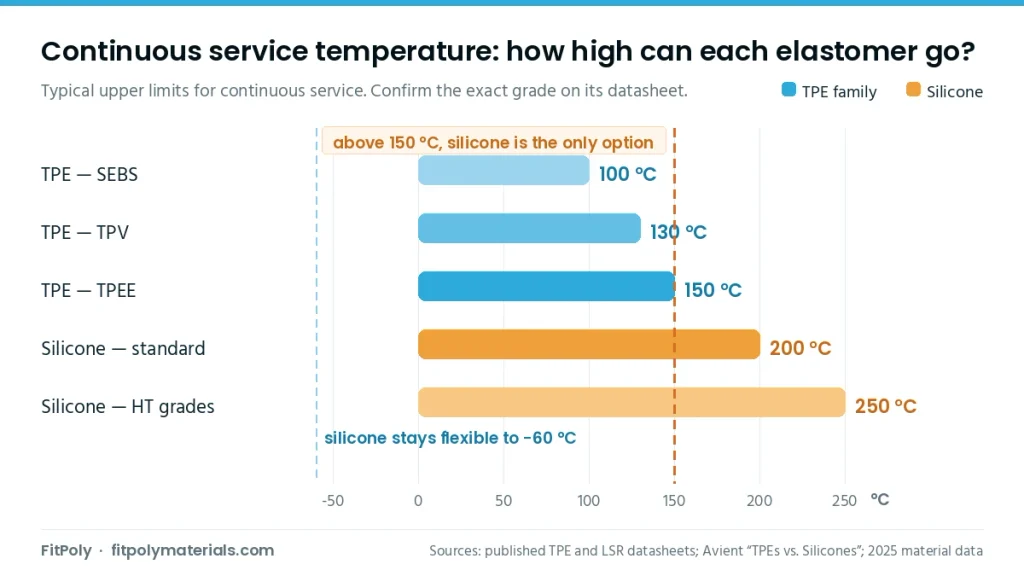
Read it as a crossover at 150 °C. Below that line the TPE family — SEBS, TPV and TPEE — covers the application at a lower cost per part; above it, only silicone survives continuous service, and high-temperature grades extend that to about 250 °C. Silicone also stays flexible down to about −60 °C.
Where does the cost gap really come from?
Resin price is the number buyers see first, but it explains only part of the gap:
- Parts per pound. LSR’s specific gravity of 1.12–1.15 against 0.89 for a base SEBS grade means about 20 % fewer parts per pound — you buy more kilograms for the same part count (Avient, “TPEs vs. Silicones”).
- Machine time. TPE demolds in 15–40 seconds; LSR needs 30–90 seconds on dedicated meter-mix equipment, plus an oven post-cure (typically about 4 hours at 200 °C) for medical and food-contact grades.
- Tooling. Cold-deck LSR tooling runs USD 15,000–80,000 against USD 10,000–50,000 for TPE in 2025 quotes, so small silicone programs rarely earn it back.
Three numbers explain most of the cost gap, and resin price is only one of them.
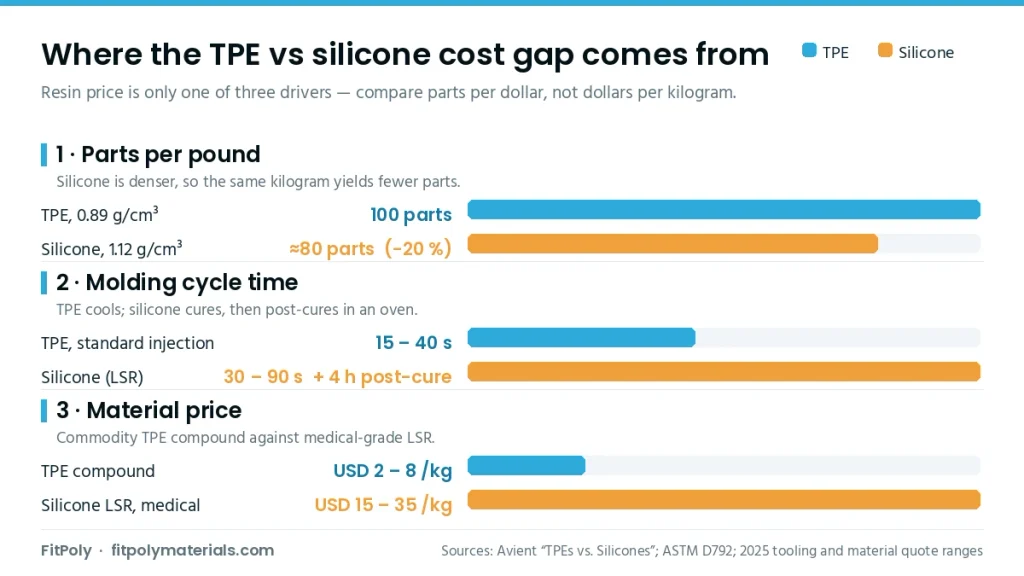
Only the third bar is resin price. The first two are structural: silicone’s density of 1.12 g/cm³ against 0.89 for a base SEBS grade means about 20 % fewer parts per pound, and a 30–90 s LSR cycle with an oven post-cure consumes machine time that TPE never spends. That is why a soft-touch part produced in the tens or hundreds of thousands is almost always cheaper in TPE.
With resin itself at USD 2–8/kg for commodity TPE against USD 15–35/kg for medical LSR, the rule is simple: compare parts per dollar, not dollars per kilogram.
When should you choose TPE?
- Volume is real and cost per part rules. Seconds-per-cycle molding with reusable scrap pays off from tens of thousands of parts upward.
- You are overmolding onto plastic. TPE bonds directly to PP, PE, ABS, PC/ABS and PA with the matching grade, adding a soft-touch layer in one operation without primer or adhesive.
- You need a wide hardness window. Shore OO 20 to Shore A 95 covers a soft grip and a semi-rigid seal in one material family.
- Sustainability is on the brief. TPE regrind is reprocessable, and RoHS (2011/65/EU) and REACH SVHC documentation is available.
TPE shrinks about 2 % while a rigid substrate shrinks about 1 %; specify a substrate at least twice as thick as the overmolded layer to avoid warpage (Avient). Typical TPE parts: phone cases, earbud tips, watch straps, tool grips and cable strain relief.
When should you choose silicone?
- The part sees real heat. Standard silicone covers −60 to +200 °C continuous; high-temperature compounds hold roughly 250 °C. No TPE grade gets close.
- You need extreme cold flexibility. Silicone stays elastic to about −60 °C.
- Compression set is critical. At 22 h / 100 °C silicone takes 10–25 % set against 25–55 % for many TPEs, so seals holding force for years favour silicone.
- Medical, food-contact or sterilization duty is specified. Platinum-cured silicone has decades of FDA 21 CFR 177.2600, USP Class VI and ISO 10993 history and survives steam sterilization at 121–134 °C; certified TPE grades exist but need more justification.
Typical silicone parts: bakeware, medical tubing, infant products, steam seals, lighting gaskets and outdoor components. One trade-off: silicone tear strength is relatively low, so a nick in a thin section can propagate.
Which TPE grade covers the middle ground?
If you want TPE processing with rubber-like sealing performance, a thermoplastic vulcanizate (TPV) is usually the answer. A TPV is a dynamically vulcanized EPDM phase in a polypropylene matrix. Density is about 0.95 g/cm³, continuous use reaches roughly 130 °C, and compression set, oil resistance and heat ageing all beat a plain SEBS compound — though still short of silicone’s 200 °C ceiling.
Our thermoplastic elastomer grades span SEBS, TPV, TPU and TPEE, so hardness, temperature and oil resistance can be matched to the drawing.
How do you decide in five questions?
- Continuous service above 150 °C, or repeated steam sterilization? Then silicone.
- Continuous use below −50 °C? Then silicone, or a specialty low-temperature TPE.
- High annual volume with cost pressure? Then TPE — press time dominates.
- Overmolding onto a rigid plastic substrate? Then TPE.
- Sealing force that must hold for years under load? Then silicone or TPV.
FAQ: TPE vs Silicone
Is TPE as heat-resistant as silicone?
No. SEBS-based TPE compounds are typically rated 70–100 °C continuous, TPV reaches roughly 130 °C and TPEE about 150 °C. Standard silicone covers −60 to +200 °C and high-temperature grades hold 250 °C. If the part must pass a 150 °C ageing test, that decision is already made.
How much cheaper is TPE than silicone?
On material and processing. Commodity TPE compounds run about USD 2–8/kg against USD 15–35/kg for medical-grade LSR, and TPE cycles in 15–40 seconds where LSR needs 30–90 seconds plus a post-cure, with about 20 % fewer parts per pound.
Can TPE replace silicone in medical devices?
Sometimes. USP Class VI and ISO 10993-tested TPE grades are used in tubing, masks, closures and wearables; medical TPU is common in catheters. Silicone still wins for implantable or long-term body contact, repeated steam sterilization at 121–134 °C, and programs built on an FDA 21 CFR 177.2600 predicate. Back any substitution with a biological evaluation to ISO 10993-1.
Why does silicone feel tackier than TPE?
Silicone has low surface energy, which is why it releases from molds and resists adhesives without a primer, and its crosslinked network gives a high-friction, slightly tacky grip. TPE can be formulated from velvety matte to smooth and glossy, so feel is usually a formulation decision.
Which elastomer fits your part?
Temperature, volume and cost decide most projects — and a good compounder can often reformulate TPE to cover applications you assumed needed silicone. Send the service temperature, hardness target, overmolding substrate and annual volume, and we will quote a grade, a sample and a cycle-time estimate.
Submit your specification at fitpolymaterials.com/contact — a sample trial settles the TPE vs silicone question faster than any comparison table.