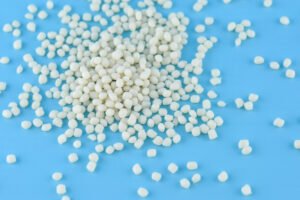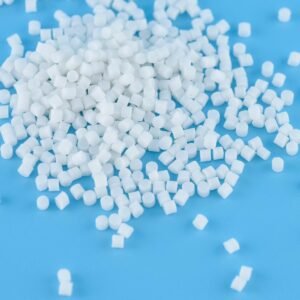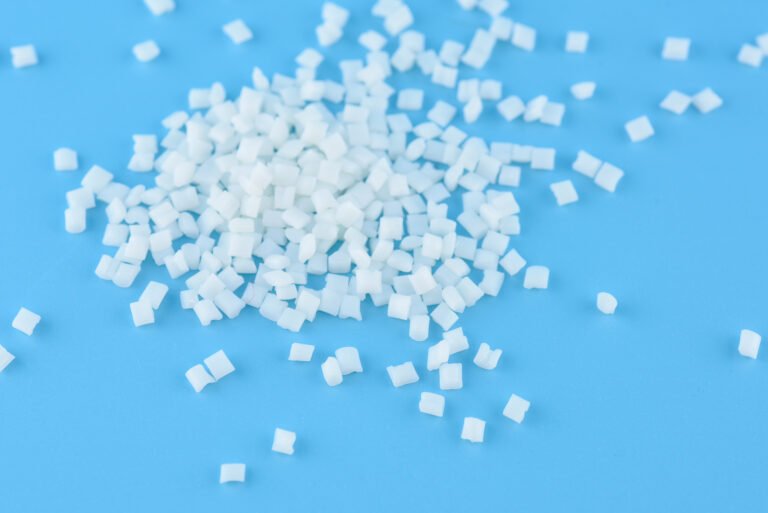
TPEE (thermoplastic polyester elastomer) replaces metal and rubber in automotive parts because it combines the load-bearing strength of an engineering plastic with the elastic flex-fatigue life of rubber in one melt-processable material. The payoff is lighter, quieter, corrosion-free parts that consolidate multi-piece assemblies, cut machining and vulcanization steps, and keep working through millions of flex cycles across a -40°C to 150°C service window.
What Is TPEE, and What Makes It Different?
TPEE (thermoplastic polyester elastomer) is a block copolymer built from two alternating segments: hard, crystalline polyester blocks (PBT-type) and soft, amorphous polyether blocks. The hard segments deliver strength, stiffness, heat resistance, and load-bearing capacity. The soft segments deliver elasticity, low-temperature flexibility, and the flex-fatigue resistance that lets a part bend millions of times without cracking. Polyether-based soft segments are chosen for the widest low-temperature flexibility, and the hard-to-soft ratio is tuned grade by grade to trade stiffness against elasticity.
Because it is a thermoplastic, not a thermoset, TPEE melts and re-melts. It runs on standard injection molding, blow molding, and extrusion lines, and clean regrind can be reprocessed. Rubber cannot do that — once vulcanized, a rubber part is cured for good, and scrap ends up as landfill or low-value filler.
Why Does TPEE Outperform Rubber in Automotive Parts?
Rubber bends well, but it loses to TPEE on four points that decide whether a part lasts under the hood:
- Flex fatigue. TPEE survives millions of bending and compression cycles without cracking or tearing — the reason it owns CVJ boots and bellows.
- Creep and stress relaxation. Under sustained load, rubber slowly deforms and a seal loses its sealing force. TPEE’s crystalline hard segments hold shape, so bushings, mounts, and seals keep their preload.
- Load-bearing capacity. TPEE carries far higher loads at a given wall thickness, so parts can be thinner and lighter than their rubber equivalents.
- Chemical resistance. Fuels, hydraulic fluids, grease, and oils attack and swell many rubbers. TPEE shrugs them off.
There is also a processing argument. Rubber needs compounding, milling, and vulcanization — a batch process with slow cycle times. TPEE is pellet-in, part-out on a normal injection machine, with faster cycles and reclaimable regrind.
Where Does TPEE Replace Metal?
Metal is strong but heavy, rusts, transmits vibration, and needs machining, welding, and finishing. TPEE steps in where a part must flex or seal and metal simply cannot:
- CVJ boots (constant velocity joint boots). The boot must flex continuously while sealing grease against dirt and water. Rubber tears over time; metal cannot flex at all. TPEE flexes for the life of the joint and resists the grease it seals in.
- Air intake ducts and blow-molded bellows. TPEE blow-molds complex ducts and bellows in a single step — lighter than welded metal, no corrosion, and quieter in the vehicle.
- Suspension bushings and silent gears. TPEE gears run quieter than metal gears, need no lubrication, and damp vibration instead of transmitting it.
The weight argument is hard to ignore: TPEE sits around 1.1–1.2 g/cm³, roughly one-sixth the weight of steel. A single molded TPEE part frequently replaces a multi-piece stamped-and-welded metal assembly, cutting part count, assembly time, and cost. Where a part needs maximum stiffness at high temperature, glass-filled engineering plastics such as PA66 remain the better choice — TPEE is the answer when the part must also flex, seal, or absorb impact.
The same combination shows up well beyond automotive. Industrial silent gears, shaft couplings, hydraulic hoses, and seals use TPEE for the same reason: quiet, lube-free, fatigue-resistant motion. On the consumer side, the material appears in athletic shoe midsoles, ski boots, and cable jackets, where rebound, cold-weather flexibility, and cut resistance decide the part.
TPEE vs. Rubber vs. Metal: How Do They Compare?
| Property | TPEE | Rubber | Metal |
|---|---|---|---|
| Flex fatigue life | Millions of cycles, no cracking | Good, but tears and cracks with age and UV | Fatigues and cracks under repeated stress |
| Creep under sustained load | Low — crystalline hard segments hold shape | High — relaxes and loses sealing force | Very low |
| Resistance to fuels, oils, grease | Excellent | Varies — many rubbers swell | Corrodes; needs coating |
| Density | ~1.1–1.2 g/cm³ | ~0.9–1.5 g/cm³ | ~7.8 g/cm³ (steel) |
| Processing | Injection/blow molding; regrind reusable | Compounding + vulcanization (thermoset) | Machining, welding, finishing |
| Noise and vibration | Damps well | Damps well | Transmits; needs isolation |
| Continuous temperature range | -40°C to 150°C | Narrower; degrades at extremes | Wide (but no damping) |
Which TPEE Grades and Modifications Are Available?
TPEE spans a hardness range from roughly 30 to 82 Shore D, so one material family can cover a soft seal through a semi-rigid structural housing. For specific applications, grades are modified:
- Glass fiber reinforcement raises stiffness and dimensional stability for load-bearing parts.
- Flame-retardant grades meet UL94 requirements for under-hood and electrical applications.
- UV stabilizers protect exterior and exposed parts from sunlight degradation.
Compared with TPU, TPEE keeps its stiffness and creep resistance to higher temperatures, which is why it is preferred for under-hood and high-load parts where TPU softens.
FAQ: TPEE for Automotive Parts
What temperature range can TPEE handle?
TPEE typically works continuously from -40°C to 150°C, with short-term excursions above that. The low-temperature flexibility down to -40°C is what lets a CVJ boot flex on a cold start without cracking.
Is TPEE harder than rubber?
Yes. Rubber mostly sits in the Shore A range, while TPEE runs from about 30 to 82 Shore D. That lets one TPEE grade replace both a soft sealing lip and a semi-rigid housing in the same part family.
Does TPEE cost more than rubber or metal?
Per kilogram, TPEE usually costs more than EPDM rubber or steel. Per finished part, it often costs less: one-step molding with no vulcanization, faster cycle times, thinner walls, no corrosion coating, and reclaimable regrind.
How is TPEE different from TPU?
Both are thermoplastic elastomers, but they split on temperature and chemistry. TPEE holds stiffness and creep resistance to higher continuous-use temperatures (up to about 150°C) and resists fuels and oils better, with less heat build-up under repeated flexing. TPU offers higher abrasion resistance and is often the cheaper pick for lower-temperature, high-wear parts.
Get a TPEE Grade Recommendation for Your Part
Tell us the part, the load, the temperature range, and the fluid it touches. Our engineers will match a TPEE grade — or tell you straight if a reinforced plastic or a different elastomer fits better. Send your spec.